
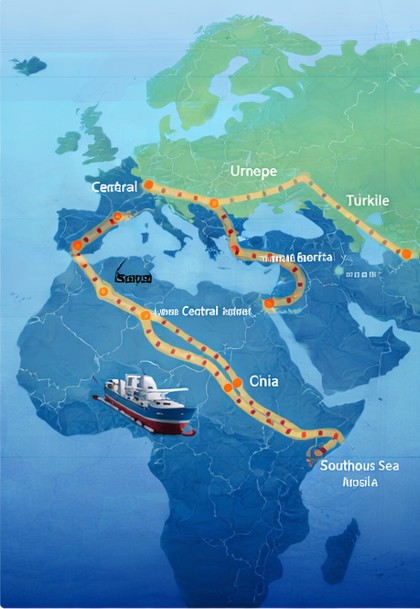





The Trans-Caspian Transport Corridor (TCTC) has emerged as a focal point for infrastructure development and trade facilitation in Eurasia. Recent analyses suggest that significant investments in this corridor could catalyze economic growth and create millions of jobs across Europe and Central Asia.
Infrastructure Development and Strategic Importance
The TCTC serves as a vital link connecting Europe, the Caucasus, and Asia via the Caspian Sea. It encompasses key transport routes that facilitate the movement of goods, enhancing trade efficiency. As global demand for alternative trade routes escalates, the importance of this corridor is increasingly recognized.
Governments and private investors are considering substantial investments aimed at improving logistics and transport capabilities along the corridor. Officials believe that enhancing this infrastructure will streamline transit times and reduce costs for businesses, paving the way for a more integrated regional economy.
The strategic importance of the TCTC is underscored by its potential to connect various markets, offering a viable alternative to traditional routes. This could be especially beneficial for landlocked countries in Central Asia, which rely heavily on efficient transport networks to access international markets.
Economic Impact and Job Creation
The anticipated investments in the Trans-Caspian route are expected to have far-reaching economic implications. By boosting trade and improving logistics, the corridor could create millions of jobs in sectors such as transportation, logistics, and manufacturing. This job creation would not only benefit countries directly involved in the corridor but could also stimulate growth in neighboring regions.
Experts note that enhancing the TCTC could lead to the establishment of logistics hubs, distribution centers, and manufacturing facilities along its route. Such developments would likely attract foreign investment and foster local entrepreneurship, thus contributing to a more vibrant economic landscape.
Moreover, the job creation potential extends beyond direct employment. Indirect benefits could arise in sectors such as services, retail, and hospitality, as increased trade activity drives demand in various industries.
Collaborative Efforts and Regional Partnerships
To realize the potential of the Trans-Caspian Transport Corridor, collaborative efforts between countries and organizations will be essential. Regional partnerships can facilitate knowledge sharing, investment pooling, and coordinated policy-making, all of which are crucial for effective implementation.
Countries involved in the TCTC have begun to recognize the importance of cooperation to enhance the corridor's efficiency. Initiatives aimed at harmonizing regulations and streamlining customs procedures are already underway. These measures are expected to further reduce transit times and increase the corridor's competitiveness relative to other trade routes.
Additionally, international organizations and financial institutions are showing interest in supporting TCTC projects. By providing funding and expertise, these entities can help bolster infrastructure development, ensuring that the corridor reaches its full potential.
### Conclusion
The prospects for the Trans-Caspian Transport Corridor appear promising, particularly in light of potential investments that could drive economic growth and job creation. As stakeholders work collaboratively to enhance infrastructure and streamline logistics, the corridor may play a pivotal role in shaping the trade landscape of Europe and Central Asia. The realization of this potential will depend on sustained cooperation and strategic investments in the coming years.
Silk Road Economic Belt Map

Map overview of Eurasian corridors and trade routes.
Recommended Resources
This page may contain affiliate links. If you buy through these links, we may earn a commission at no extra cost to you.
Logistics & Supply Chain Book
Useful background reading for transport corridors, trade routes, and supply chains.
View ResourceTrade Data Platform
A platform for researching trade flows, customs data, and freight trends.
Open PlatformBusiness Travel Insurance
Optional partner offer for readers traveling across Eurasia for business.
Check Offer