
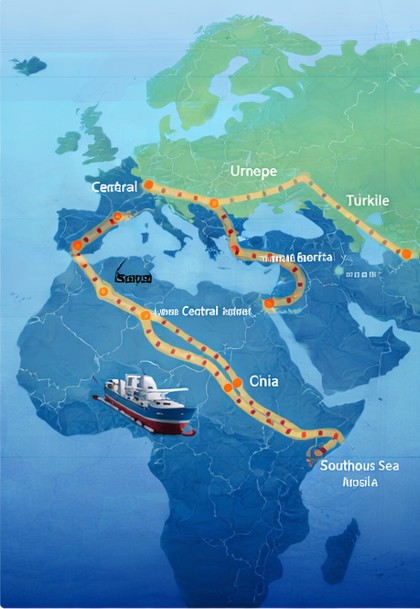





Introduction to the Middle Corridor
The Middle Corridor, an integral part of the broader Belt and Road Initiative (BRI), is gaining prominence as a key trade route connecting Asia with Europe through Central Asia. This corridor runs through several countries, including Azerbaijan, Georgia, and Turkey, and is expected to enhance trade logistics significantly in the Eurasian region.
Historically, trade routes have played a vital role in shaping economic relationships, and the Middle Corridor is poised to do the same. By providing an alternative to existing shipping routes, particularly those that pass through Russia and the Suez Canal, this corridor offers diverse geopolitical advantages that could reshape trade patterns in Eurasia.
Infrastructure Developments
To fully realize the potential of the Middle Corridor, significant investments in infrastructure are underway. Key projects include the construction and modernization of railways, highways, and ports, which are crucial for facilitating efficient transportation of goods.
For instance, the Baku-Tbilisi-Kars railway, completed in 2017, serves as a critical link connecting Azerbaijan, Georgia, and Turkey. This railway enhances connectivity and reduces transit times for goods traveling between Asia and Europe. Additionally, investments in port facilities, such as the Port of Baku, are designed to handle increasing cargo volumes and improve overall logistics capacity.
To support these infrastructures, various governments and private entities are collaborating to ensure a streamlined logistics network. This cooperation is essential for addressing challenges related to customs, regulatory policies, and transportation management, which can often hinder trade.
Strategic Economic Implications
The Middle Corridor presents several strategic economic implications for the countries involved. For Central Asian nations, it provides an opportunity to diversify their economies and reduce reliance on traditional trade partners. This diversification can lead to enhanced economic resilience and growth.
Moreover, the corridor opens new avenues for investment, particularly in sectors like logistics, manufacturing, and technology. As countries along the route improve their infrastructure, they become more attractive to foreign investors seeking to tap into emerging markets.
Additionally, the Middle Corridor could foster regional cooperation among participating countries. By establishing a network of trade routes, nations can work together to optimize logistics and improve trade facilitation. This collaboration could lead to broader economic integration and stability across the region.
Challenges and Considerations
Despite its potential, the Middle Corridor faces several challenges that could impact its effectiveness. Geopolitical tensions in the region, particularly involving major powers like Russia and China, can complicate cooperation efforts. Additionally, varying regulatory environments and customs procedures among countries may pose obstacles to smooth trade operations.
Furthermore, the ongoing global supply chain disruptions, exacerbated by the COVID-19 pandemic, highlight the vulnerabilities of international logistics. The Middle Corridor must adapt to these changes to remain a viable alternative for trade.
Environmental considerations also emerge as a key concern. As countries invest in infrastructure, the need for sustainable practices becomes increasingly crucial to mitigate potential ecological impacts.
Conclusion
The Middle Corridor is on track to become a significant player in Eurasian trade, driven by substantial infrastructure investments and strategic economic implications. While challenges remain, its development may offer new opportunities for enhanced trade and cooperation across the region. As stakeholders continue to navigate the complexities of the logistics landscape, the corridor's evolution will be closely watched in the context of global economic dynamics.
Silk Road Economic Belt Map

Map overview of Eurasian corridors and trade routes.
Recommended Resources
This page may contain affiliate links. If you buy through these links, we may earn a commission at no extra cost to you.
Logistics & Supply Chain Book
Useful background reading for transport corridors, trade routes, and supply chains.
View ResourceTrade Data Platform
A platform for researching trade flows, customs data, and freight trends.
Open PlatformBusiness Travel Insurance
Optional partner offer for readers traveling across Eurasia for business.
Check Offer