
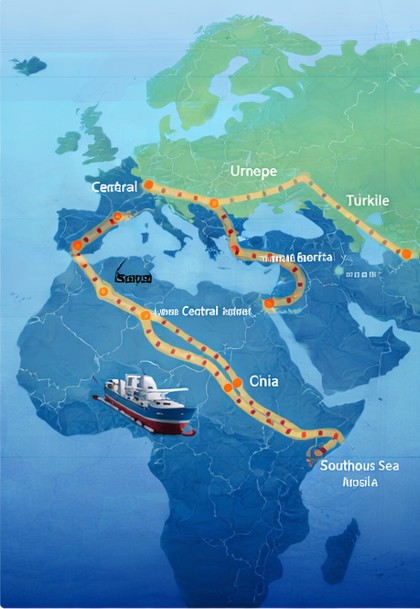





EU's Strategic Shift Towards the Middle Corridor
The European Union is increasingly focused on diversifying its trade routes to Central Asia, with the Middle Corridor emerging as a prime candidate for investment. The proposed investment of €18.5 billion aims to bolster infrastructure, logistics, and connectivity in this vital region.
The Middle Corridor, which stretches from China through Kazakhstan, Azerbaijan, and Georgia to Turkey, represents an alternative to traditional trade routes. This initiative seeks to enhance trade efficiency and reliability, particularly as geopolitical tensions impact existing supply chains.
EU officials have emphasized the importance of the Middle Corridor in the context of global trade dynamics. As the EU looks to reduce its dependence on a limited number of trade routes, investment in the Middle Corridor is seen as a strategic move to facilitate greater economic interaction with Central Asia.
Infrastructure Development Needs
The €18.5 billion investment will primarily focus on improving transportation infrastructure along the Middle Corridor. Key areas of development include railways, highways, and logistics hubs that are essential for seamless trade operations.
Current infrastructure in some regions along the corridor is inadequate to handle increasing trade volumes. By upgrading these facilities, the EU aims to enhance connectivity between Europe and Central Asia, thereby promoting economic growth in both regions.
Moreover, there is a pressing need to improve border processing facilities to expedite customs procedures. Streamlining these processes is vital for reducing transit times and costs, making the Middle Corridor a more attractive option for businesses looking to engage in international trade.
Trade Opportunities and Challenges
Investing in the Middle Corridor opens up numerous trade opportunities for the EU and its partners. Central Asia is rich in natural resources, including hydrocarbons and minerals, which are in high demand globally. The EU's access to these resources could be significantly improved through enhanced logistics and transport networks.
However, challenges remain. Political stability in some Central Asian countries can be unpredictable, impacting trade flows. Additionally, competition from other trade corridors, such as the Northern Sea Route and the Trans-Siberian Railway, may pose challenges to the Middle Corridor's development.
Despite these hurdles, the EU's commitment to investing in the Middle Corridor reflects a broader strategy to strengthen economic ties with Central Asia. By diversifying trade routes and investing in infrastructure, the EU aims to create a more resilient and interconnected trade network.
In conclusion, the proposed €18.5 billion investment in the Middle Corridor marks a significant step towards enhancing trade connectivity between Europe and Central Asia. As the EU navigates the complexities of global trade, the future of the Middle Corridor will depend on effective infrastructure development and regional cooperation.
Silk Road Economic Belt Map

Map overview of Eurasian corridors and trade routes.
Recommended Resources
This page may contain affiliate links. If you buy through these links, we may earn a commission at no extra cost to you.
Logistics & Supply Chain Book
Useful background reading for transport corridors, trade routes, and supply chains.
View ResourceTrade Data Platform
A platform for researching trade flows, customs data, and freight trends.
Open PlatformBusiness Travel Insurance
Optional partner offer for readers traveling across Eurasia for business.
Check Offer